Advanced Voice Mode: A Game-Changer for Conversations and Beyond
This week OpenAI released the long-awaited (and much delayed) advanced voice mode.

Excitement
This week OpenAI released the long awaited (and much delayed) advanced voice mode. After all the anticipation and reports from early US users, I couldn’t wait to try out what seemed like a real product differentiator from the leading AI lab.

Disappointment
Immediately I tried it out…but it was just like before. Sadly, it was confirmed shortly afterwards that it was not available in the UK (where I am) nor the EU, or the other Western European countries not in the EU.

Why the delay?
A popular assumption was that it may be due to ludicrous EU AI regulation pertaining to the detection of emotion. However, the UK is no longer a part of the union, and the likes of Switzerland and Liechtenstein have never joined.
Today, in what may be the first benefit of Brexit, it was rolled out.

Winning over “la boss”
First impressions did not disappoint. I previously used the “Sky” voice that was removed following the “Her” Scarlett Johansson controversy. Asked to pick a new one, I went with Sol, a “savvy and relaxed” American woman.
My wife was with me when I made the switch, and she immediately asked, “Why did you choose a girl’s voice? Are you planning on falling in love with her?” In response, I told Sol about my wife’s playful concern. Sol responded coolly, making a joke of her own and complimenting my wife’s sense of humour. Nice.
I decided to take it a step further. My wife is French, and I don’t speak French. So I asked Sol, “Please tell my wife in French how beautiful she is and how much I love her.” In an instant, Sol translated my message in flawless French. My wife smiled. Nice.
The kids
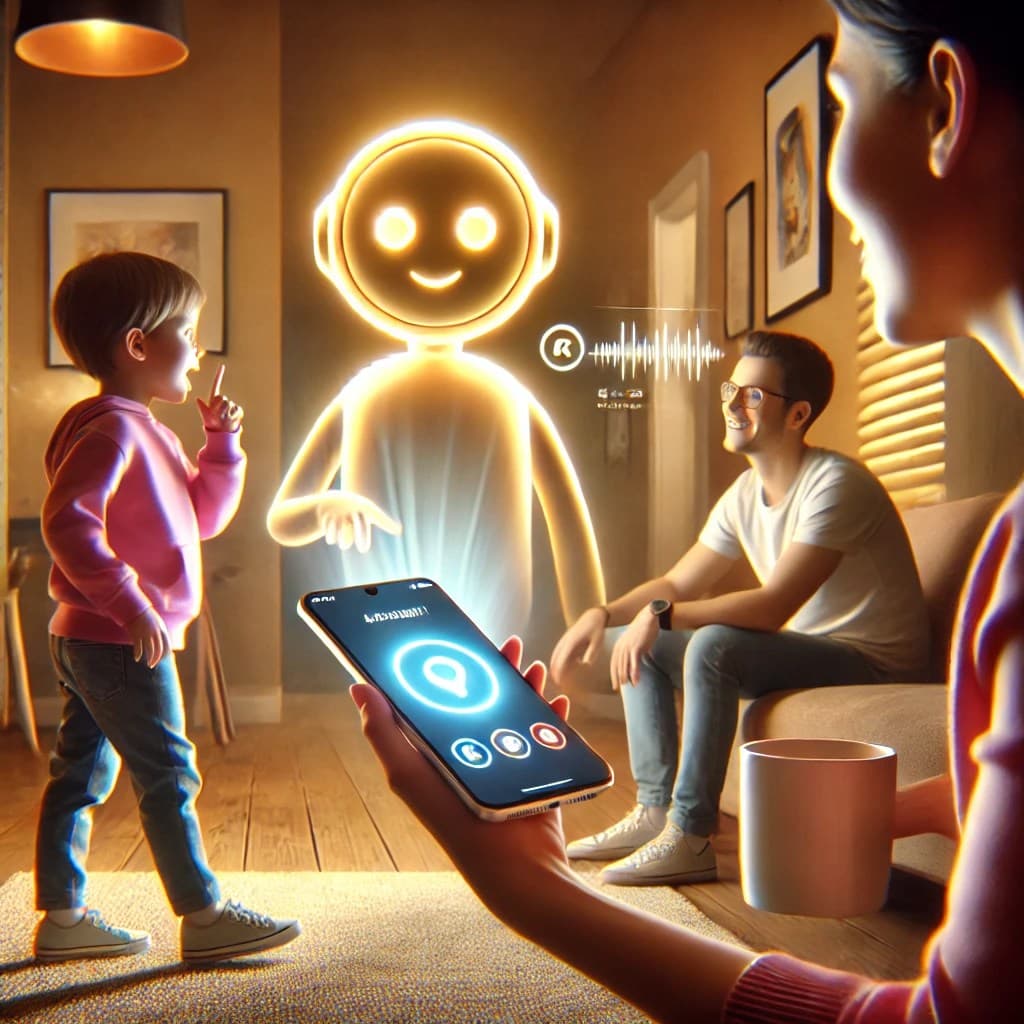
I then introduced her to my children, aged four and one (nearly two). She greeted them and asked about their favourite animals (sharks and polar bears, respectively). My daughter was thrilled, particularly when Sol used her name. She seemed genuinely captivated, a spark of joy though she almost certainly thought she was talking to a real person. My son, however, took it in stride when I told him Sol was a robot. For him, this almost magical technology will be entirely normal throughout his life.
The Product
Talking to the app feels like talking to a person — perhaps someone on the phone — but still, a person. The interaction is fast, natural, and natively conversational. Sol has a distinct personality: playful, fun, and capable of picking up emotional cues. This would be successful even if it was not useful.
But it is useful. As a translation tool, it’s brilliant. I once had a 1000+ day Duolingo streak but found that while my vocabulary improved, my speaking ability remained dire. Duolingo is an engaging product with excellent gamification, but in my experience, it doesn’t truly teach you to speak fluently.
With ChatGPT, you can ask for personalised language lessons and progress at your own pace. You really converse. And if, like me, you’ve given up on learning, for better or worse you can now practically converse with your French in-laws — or understand your wife’s profanities!
Rather than typing everyday queries into the tool, you can simply talk or show it what you see. It’s more human, natural, and nuanced. This kind of interaction will become more common, especially with the emergence of new interfaces like smart glasses, pins, or enhanced watches. While smartphones aren’t going away anytime soon, the way we interact with them is evolving fast — the future is already here (unless you live in the EU).
