"Anaximander and the Birth of Science" – Book Review
Anaximander is a captivating and insightful exploration of the world's first scientist, offering a profound celebration of science and its origins.
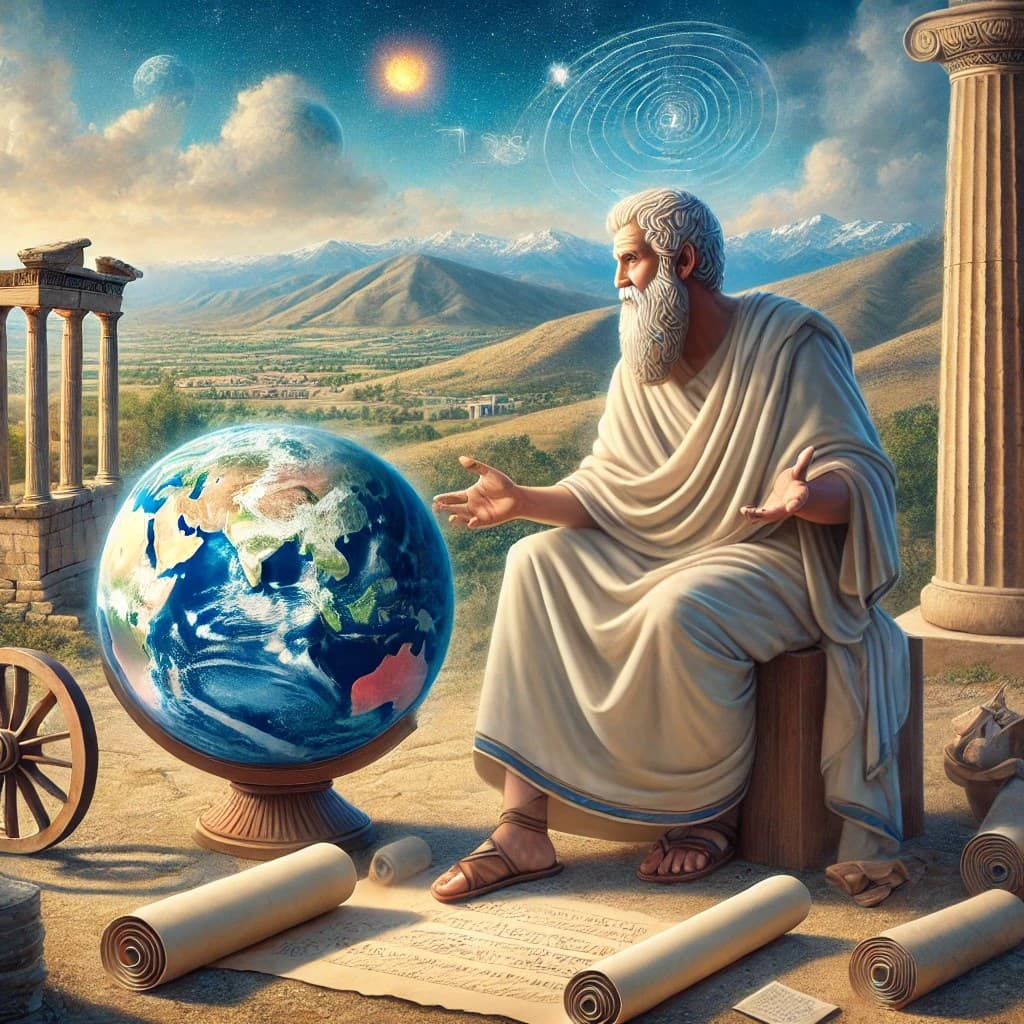
“Anaximander” is a captivating and insightful exploration of the world’s first scientist, offering a profound celebration of science and its origins. As with Rovelli’s other works, this book is always interesting, blending intellectual depth with accessible storytelling.
Anaximander was born in Miletus, a city in ancient Ionia (modern-day Turkey), in the 6th century BCE. He was an ancient Greek thinker who sought natural explanations for the phenomena of the universe, moving away from mythological interpretations. His ground-breaking ideas laid the foundations for rationality, astronomy, geography, and conceptual tools like natural laws and theoretical postulation.

The World’s First Scientist?
We know little directly about him and his ideas. Most of our knowledge comes third hand from writings centuries later. But from that we can see his contributions represent proto-science, offering the first natural explanations for the world free of myths or gods. Some ideas, like his concept of evolution, are astonishingly advanced. He correctly states that humans must have originally come from sea creatures. Others, such as the Earth being shaped like a cylinder, are less convincing, but it is here Rovelli spots his key innovation – moving from the assumption of “rock all the way down” to “there’s nothing holding us up”. This seemingly minor insight is highlighted as a pivotal moment in human thought. It is portrayed as the first leap of science, a “conceptual revolution” to accept facts when presented with evidence.
In saying this he was overturning both the ideas of his mentor Thales, and accepted dogmatic tradition. Thereby introducing the critical tradition – one that deliberately seeks out and corrects mistakes a “self correcting system” as Yuval Noah Harari would call it. Indeed Rovelli will state that Anaximander’s most profound contribution was recognising that we can be mistaken.
There are many other interesting threads in this book, both ancient and modern.
I did not realise that the development of the Greek alphabet was a ground-breaking moment in history. It was the first fully phonetic system (until Esperanto), it was designed to be read aloud without prior knowledge. This innovation made knowledge accessible, contrasting with earlier systems controlled by scribes and priests. Following the Greek Dark Ages, this open system revived learning and set the stage for broader intellectual progress.
A Sign of the Times
Democracy and science both thrive on reasoned discussion, arguments, and evidence based conclusions. They thrive in societies free from god-king myths that enable collective inquiry. Anaximander’s work would only be possible inside the thriving democratic culture he was born into. From Anaximander’s time until the fall of the Roman Republic, critical thinking spread and pushed humanity forwards, admittedly not without pushback. Once the Emperors and then Popes revived theocracy, especially under the monotheistic Christians, we were led into the more familiar Dark Ages, an era marked by the absence of democracy and scientific advancement.
Science Happens in the Mind
Back in modern times we are presented with Science as Visionary Thought. Science begins in the mind, not with technical tools but with new ways of seeing the world. Anaximander’s perspective revealed new realms of reality. Rovelli traces this intellectual lineage through the astronomy of Copernicus and Ptolemy, then Einstein and his own work in quantum gravity. He highlights Einstein’s leap with relativity, imagining what it would be like riding a beam of light – while embracing prior discoveries allowing the discarding of assumed a priori truths like the simultaneity of time. Similarly, Rovelli’s research views time itself as an artefact of special conditions, following the same pattern of conceptual revolutions bringing us new understandings of reality. He specifically picks out Anaximander’s methodology of uncovering “physical laws that proceed in accordance with the order of time” showing he hopes to overturn the very first scientist’s very first description of science.
Other Thoughts
This book is not just about Anaximander but the general evolution of scientific thinking and its opposite pole, religion. Rovelli critiques modern cultural relativism, noting a paper that looked at ‘western’ and Chinese astronomy and thoughts about the size of the earth and distance of the sun. Chinese thought was wrong, and when presented with Western evidence in the 16th century they changed their mind and adopted the correct view – however the paper refused to say that one was a closer approximation of reality, saying that all cultures have truth claims. I am glad he was brave enough to state how wrong this is while not slipping into anything like xenophobia – he argues that while truth may have cultural expressions, it remains grounded in objective reality. He links Chinese respect for established facts and mentors and a stagnation in scientific development. I would say this is true by the modern birth of science in the renaissance, but strikes me as false for the 1000 years beforehand. Most advances were Chinese at this time.
A Nicer Dawkins
Chapter 10 delves into the tension between religion and rationality. Anaximander’s work – the first to rationalise the universe and cosmology – raises questions about the basic necessity of religion. He marks the violent Christian destruction of the Library of Alexandria as symbolising a return to theocracy, ushering in 1,500 years of religious dominance in the West. There are some eloquent but basic arguments against religion and anti-rationalism that seem strangely out of place.
Fun fact – every ship that docked at Alexandria was forced, on pain of death, to hand over all books to the library to be copied, with the copies being returned to the captains. What a treasure we lost.
A Wild Finale
The final chapter is a wild meander reflection on human thought. I thought Rovelli’s musings were verging on the psychedelic, then indeed LSD and talking to trees comes up. There’s a reason why I appreciate his work so deeply. Another great read, though lacking the strong narrative of his other 5 star works.