Children of Memory – Book Review
A return to 5 star form adventuring with Adrian Tchaikovsky and the vestiges of humanity.
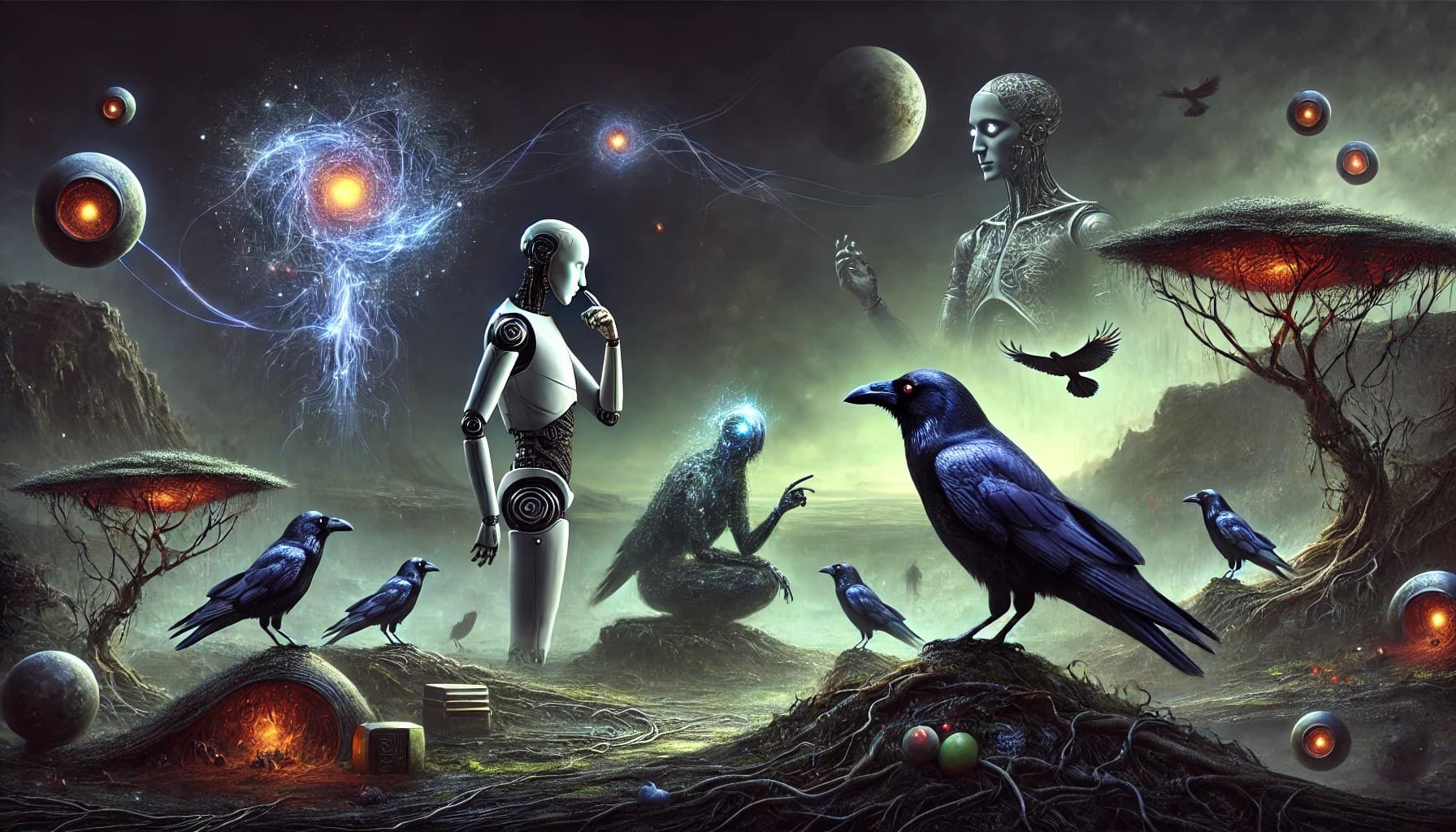
A return to 5 star form adventuring with Adrian Tchaikovsky and the vestiges of humanity. The book is a smart, funny, and dark romp through themes of ecology, evolution, philosophy, sentience, and humanity.
Our setting is a mysterious and barely terraformed planet where a Malthusian trap plays out with guilt stricken survivors.
Joining our menagerie of Human, human, AI, spider, octopus, and alien fungus minds are the corvids.

Our inventively framed new minds are basically advanced crows, and they brilliantly serve as both an innovative co-dependent intelligence and as a clear, prescient model for LLMs (“stochastic parrots”). The corvids demonstrate a striking similarity to LLMs in their ability to mimic understanding and generate responses. Like LLMs, they process and relay information based on patterns and memory, which raises questions about the nature of true thought and sentience. The birds form bonding pairs to form a greater whole, with one having an almost perfect memory and the other being able to problem solve through reason and analysis – separated they are reduced to crows we would recognise. Their mind is somewhere between their two brains.
The thought of what is sentient permeates the novel and is personified in the corvids – they insist they are not sentient. They think it would be annoying. However the AI concludes we must treat the corvids as sentient because of their careful reasoning that they are not sentient, haha 🙂
Do they think, or are they merely parroting thought itself along with great quotes from the past? The story explores whether their ability to mimic understanding represents genuine cognition or simply an advanced form of pattern recognition. This raises fascinating questions about the distinction between imitating intelligence and truly possessing it within the story’s context. Is sufficiently advanced instinct/programming indistinguishable from intelligence? Do the birds think or have they evolved to a point where they solve real problems without thought? Intelligence without sentience. The newer LLMs look to be able to solve novel problems, at least to approximate reasoning. Do they think, or is it just programming? Most people have a clear answer here (“No! It’s just programming”). The corvids see the AI as a very high functioning reasoning machine – not sentient. This troubles Kern, our ant-powered bad tempered AI but the deeper point posed is do humans think or is it an illusion? The corvids have an answer. One you may not like. And the reasoning ones often poke at this in funny ways.
There are intriguing thoughts as to what exactly can be sentient and what it means if nothing is. The birds push us to think of sentient systems as opposed to sentient beings made up of non-sentient cells warning us to not be too narrow in our conception.
Perhaps intelligence and sentience are not obvious. We may not know it when it hits us in the face. For example, the corvids’ ability to reason and problem-solve seems indistinguishable from true intelligence, yet their insistence that they lack sentience challenges our understanding of what sentience truly is. Similarly, Kern’s existential musings on human consciousness further complicate the idea, suggesting that what we perceive as thought might merely be an elaborate simulation. Later we wade into simulation theory proper, many of the discussions here too are better than the actual scientific discourse, a sign of great fiction writing. The conclusion – that if you can’t tell it does not matter, I agree with.
There are a few dark twists to the story. Enlivened with a spark of humanity from things that are very much not human. In the end it’s the feelings that count in this cold and unforgiving universe.
I loved the first book in the series, and greatly liked the second, both times wondering if a sequel could work but work it does. This book has less action than the prequels being more focused on the internal experiences of our protagonists, it can be confusing but is undoubtedly a rewarding read. Top-level philosophical science fiction.