The Coming Wave – Book Review
In The Coming Wave, we are navigated through the tumultuous waters of contemporary technological evolution.
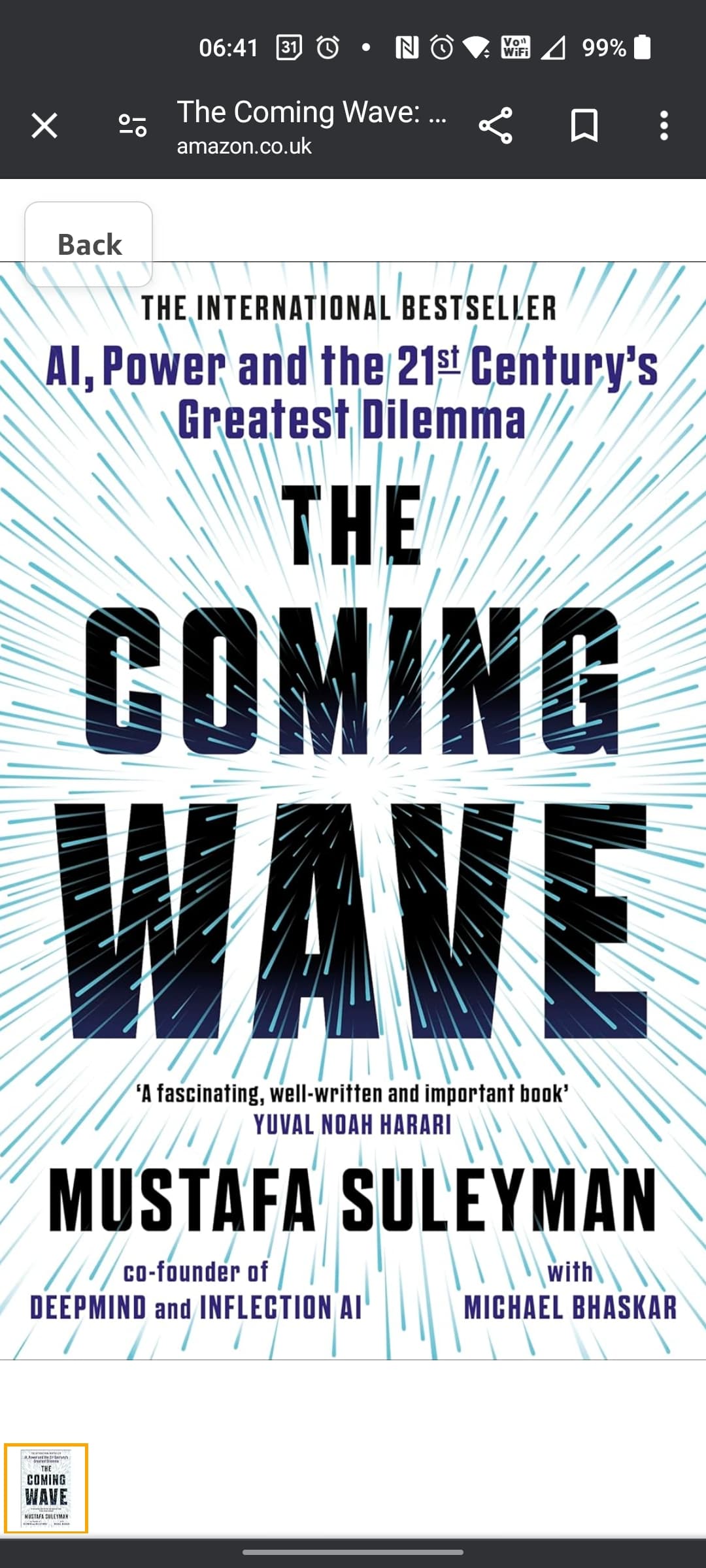
In “The Coming Wave,” we are navigated through the tumultuous waters of contemporary technological evolution. DeepMind co-founder and current CEO of Inflection AI Mustafa Suleyman posits that we stand on the cusp of a technological wave more fundamental and challenging to contain than any before – akin to a Cambrian explosion of innovation & intelligence.
The authors assert that technology has transcended the physical realm of atoms, becoming a recombinant force, analogous to language or chemistry, that exponentially feeds on itself. In two key areas, Artificial Intelligence and Synthetic Biology, this will provide huge benefits while posing immense challenges for humanity.
The realm of AI is the author’s home field, here he describes a landscape where even today there’s no upper limit to scaling, showing how daisy chaining existing chips together can shatter barriers we once deemed insurmountable. This remains to be proven but the direction and exponential speed of progress are clear for all to see.
Inflection AI released its LLM that challenges (though not surpasses) GPT4 a few months ago. Deepmind produced genuine scientific breakthroughs that shocked the world last decade, mostly in how it learned to master the games Chess and Go – changing how the best humans play them. This decade Deepmind has begun to produce genuine world changing research, especially on protein structures with Alphafold. Suleyman has skin in the game and knows what he is talking about.
A fascinating section presents a modern Turing test, not of conversational indistinguishability with a human, but of entrepreneurial autonomy: the ability of an AI agent to generate a million dollars in revenue on Amazon with minimal human intervention past the prompt. So with the searching, API connections, marketing and banking are all done by the AI agent. He suggests we are on the brink (a few years) of developing this “Artificial Capable Intelligence” where this type of self-executing to-do list programs will be realised. Interestingly he suggests the banking aspect may prove to be the most difficult part! Those pesky regulations keeping AI agents unbanked. Crypto here would offer an alternative for our AI entrepreneurs. It’s a smart way of thinking this through, and given the noises out of OpenAI and their rivals, it is indeed coming soon.
One of the book’s central themes is the democratisation of power through the plummeting cost of technology, empowering individuals and eroding traditional state controls. AI and to a lesser extent Synthetic Biology are force multipliers. This supercharging of individuals, and the masses, carries with it the risk of unintended consequences, as even well-intentioned actors find themselves wielding tools of unprecedented potency, particularly in the uncontrolled realm of synthetic biology. These sections are more focused on disaster, cleverly outlining real life accidents to show just how easy we blunder into outbreaks and pandemics (he deliberately leaves out the Covid 19 lab leak idea by highlighting several other established ones.) It is worrying. The threat is very real. Even before we talk about deliberate actions by terrorists or terrorist-state actors.
Suleyman and Bhaskar later delve into techno-nationalism, acknowledging the validity of concerns surrounding the geo-political race for technological supremacy, with China as a formidable contender. I feel the threat is slightly overstated as I believe the freedom of competition will drive better technology in the West. Granted this is a flimsy belief on such an important question. They go on to explore the dichotomy of tech and state, contemplating the amplified pace at which technology reshapes politics and society, and questioning whether this rapid evolution serves the state’s interests – be it a centralised model like China’s or a more cosmopolitan approach. The incentives for individuals and companies are also expertly analysed, why do people work on this? What do scientists want? Money, kudos, fame, to be the first? Yes, some of all of these. Without aligning safety concerns with people’s desires we could face disaster. There are solid suggestions on how to do this, ones suitable in the West at least.
The authors traverse a delicate tension between heavy state control and empowered individual actors, suggesting that a single misstep or one successful attack could result in catastrophe. They argue for robust frameworks for research, safety, and disclosures, underscoring the necessity of cooperation between companies and nations. Very wise. This is clearly required. Will this happen? Don’t bet on it.
Suleyman, with his background in public policy and at DeepMind through their acquisition by Google, brings a personal touch to the narrative, emphasising the need for collective responsibility in a field where he himself has been a key player. He calls for a commitment from all stakeholders to set a course along the “narrow path” that lies between the loss of control and the loss of freedom – a balance between openness and closure that avoids catastrophic outcomes. He details how hard it was to force AI safety as a key principle in a for profit company. See OpenAI for more of the same!
In the short term, we are given a glimpse of a bright future where intelligence empowers people and businesses to flourish. US Stock markets are again at record highs driven by the major AI companies.
However, the world will change rapidly and unevenly. There will be losers in the transformation. Klarna’s chatbot is already doing the work of thousands of customer service agents. What work will these people do next?
The medical applications of the coming wave should improve and extend countless lives beyond what people thought was possible a few decades ago. At least for those who can afford it.
In the short-to-medium term the concurrent threats will need to be neutered or catastrophe could strike. It could strike accidentally.
The policy recommendations are well thought out and wise. As mentioned the author is an insider, and he is not calling for intense public regulation, more comprehensive self regulation. A point critics are quick to point out though one I feel is unfounded.
Unfortunately, I doubt many of the ideas will be implemented. The current misalignment of incentives will be difficult to overcome. While not containing revolutionary ideas “The Coming Wave” stands as a testament to the profound implications of our technological trajectory and the critical choices that lie ahead.
