The Hidden Spring – Book Review
I made more detailed notes for Mark Solms' The Hidden Spring than any book since How Emotions are Made, a review I riff off here.

I made more detailed notes for Mark Solms' The Hidden Spring than any book since How Emotions are Made – a review I riff off here. It’s a rare thing to find a book that both blows your mind with its depth of scientific insight and leaves you grappling with philosophical implications long after you put it down.
This too is a book with an ambitious goal – to demystify the origins of consciousness and feelings by grounding them in the free energy principle. And, for my money, it largely succeeds. What’s more, it sheds light on the interplay between biology, physics, neuroscience, and even ethics in ways that feel both dazzling and unsettling. This puts it right at the top of the list of work on consciousness.
Deconstructing Our Assumptions
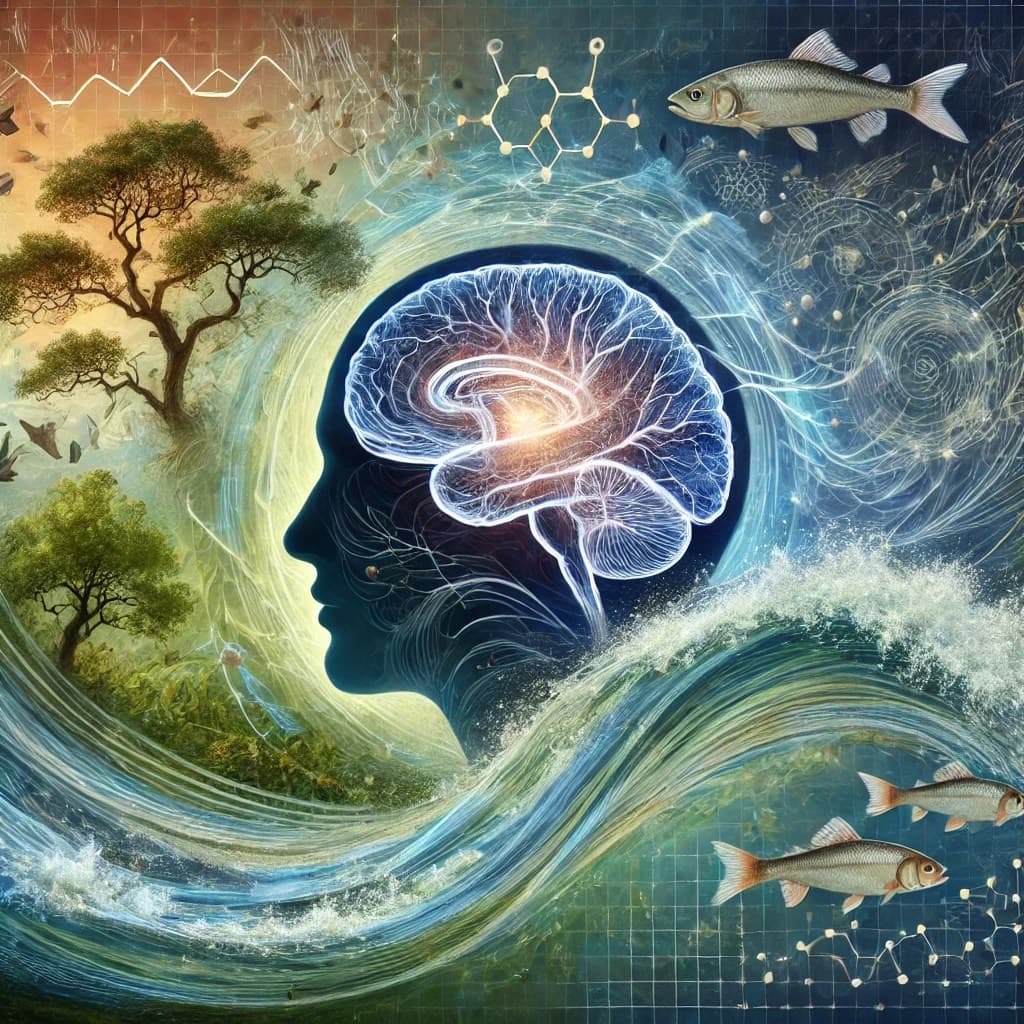
The book starts by dismantling the common idea that consciousness is tied to the higher brain functions alone. Instead, it makes a case for feelings as the true bedrock of consciousness – older than memory, language, or even rational thought. We’re shown how these primal sensations are integral to survival, rooted in ancient evolutionary systems dating back to fish. And we have a physical location, a small dense knot in brain stem that is 525m years old. This idea, that feelings are nature’s guiding force, is a profound shift away from the “rational control” narrative most of us have absorbed. The brain is presented as bottom up not top down. We know we take in more information than we can hope to process.
The argument is backed by astonishing (and tragic) examples: children born without a cortex who still display emotional consciousness; mammals engaging in maternal care and play, even when deprived of higher brain functions. It forces a rethink of what it means to be conscious and where we draw the line between instinct and awareness.
Constructing Consciousness
The free energy principle is the backbone of the book’s argument: consciousness is an emergent property of an organism’s need to maintain homeostasis. In simple terms, we need to resist entropy to survive, and feelings are the internal signals that guide us. This mechanism scales from basic survival (e.g., avoiding freezing to death) to the most abstract concepts of human life.
The exploration of feelings as predictions – error signals generated when reality deviates from expectation – is particularly fascinating. It reframes emotions not as irrational outbursts but as finely tuned systems designed to keep us alive. Feelings are the wellspring of consciousness. We know what we feel but not always why. The book beautifully illustrates this with examples, from fear as a protective blessing to how emotions inform decision-making in the face of uncertainty.
Many of the ideas are backed up from both the other top scientists from today such as Antonio Damasio, and our long dead friends such as Sigmund Freud – who has quite the rehabilitation here. The author has consciousness evolving instead of a memory trace – it’s for things where we need to learn from experience, for feeling a way through a situation. Once navigated, we look to automate and speed up the process. Drive vs reflex. Using short term memory, dealing with uncertainty is what can be called hard system 2 thinking, reasoning and intentionality. The largest errors really are our best learning opportunities! (As long as we don’t die.)
Highlights and Surprises
The breadth of ideas in The Hidden Spring is staggering. The sections on the Markov blanket, which separates the “self” from the external environment, are revelatory. They describe how organisms model their surroundings and use these models to act – a process that is foundational to subjectivity.
The discussion of perception is equally thrilling. The brain, it turns out, is far less interested in external input than you’d think. Most of what we “see” is a predictive model, informed by past experiences and updated only when reality surprises us. The comparison to generative AI tools is apt – our minds fill in gaps with astonishing efficiency. So much of the language overlaps with AI/ML terminology such as “weightings,” “confidence optimisations,” “corrections,” and “expected strength.” The book frames the striking similarities between biological processes and artificial systems, suggesting that both operate as prediction machines adapting to minimise error. It raises fascinating questions about the potential to bridge these domains and what this means for our understanding of consciousness.
Practical and Ethical Implications
As the book shifts into the implications of its theory, it becomes both exciting and troubling. The author is trying to create consciousness in machines, creating conscious programs. Incredibly inventive but the ethical dilemmas are profound. What happens when we build machines capable of feeling? Would their suffering be our responsibility? (Yes). The book doesn’t shy away from these questions, and its answers are worrying. The number one reason why consciousness evolved is to increase the chances of survival. What is the greatest threat to any machine or program we endow with it? Us. This, maybe more than raw intelligence is increasing my pdoom. And we may do it unintentionally.
There’s also an unexpected practicality here. The book’s insights into how emotions and consciousness function provide tools for better living. Understanding that feelings arise from prediction errors helps frame anxiety, fear, and even joy as signals to be worked with rather than battled against.
A Transformative Read
This is first-rate science writing, deeply rooted in evidence yet unafraid to speculate. He gives an answer on “The hard problem” and a reason why it has not been solved (before now?). Great!
The prose is occasionally dense, especially on the physics! But the payoff is worth it. The book builds on How Emotions are Made, subsuming the ideas there while moving us back towards more fundamental emotions that were thrown out in that work. He states that all mammals and birds have 7 core emotions. These two seem to be the poles in the field.
It may not prove to be correct but The Hidden Spring can spark a revolution in how we understand consciousness and emotion. It feels like the right path, it feels like explanations to consciousness have never been so close. It’s a challenging but rewarding read – one that lingers long after you’ve turned the final page.