“The Man From the Future” Book review
John von Neumann, considered by some to be the smartest man of all time, certainly lives up to the title of the biography.
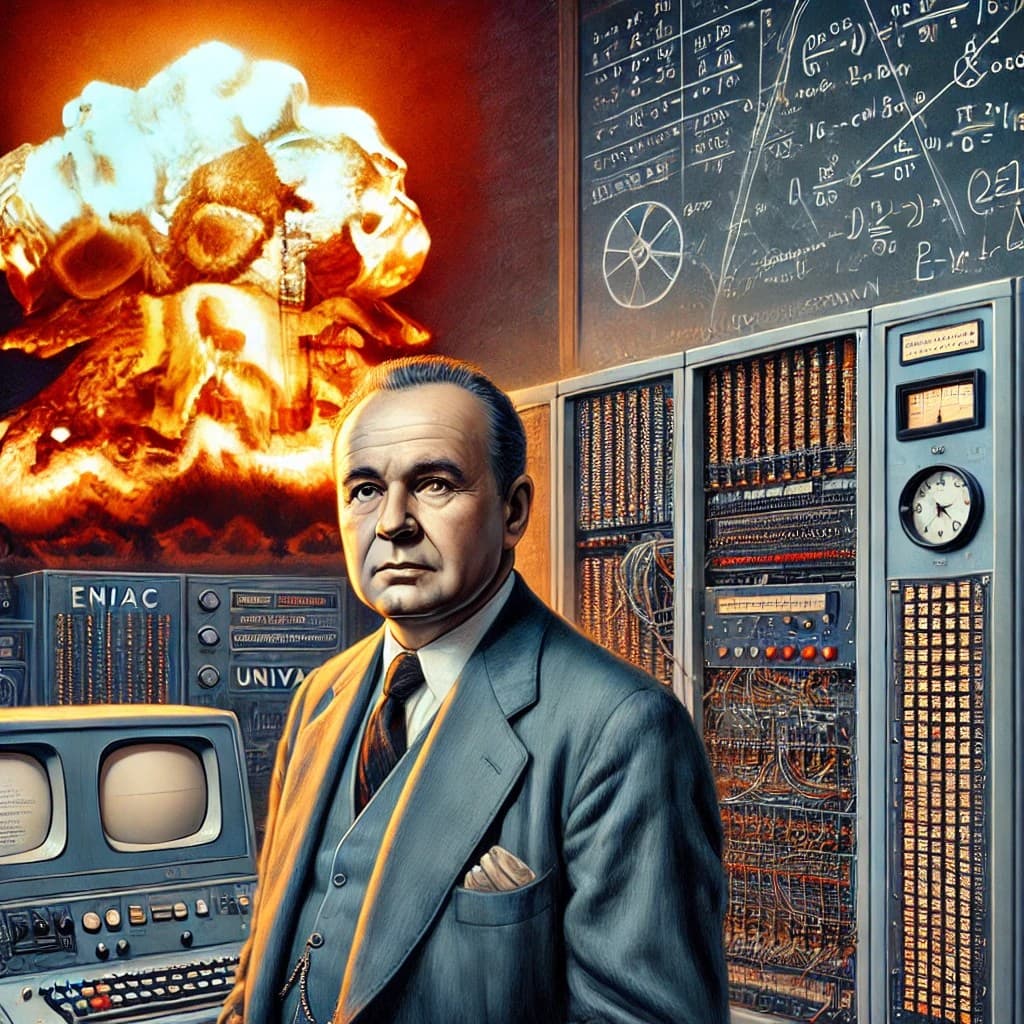
John von Neumann, considered by some to be the smartest man of all time, certainly lives up to the title of the biography. A visionary and pioneer across multiple fields, von Neumann made ground-breaking contributions to areas ranging from pure mathematics, nuclear weapons, digital computing, AI and economics. In many ways we live in a future he envisioned. Has anyone else had a greater individual impact on modernity? His achievements certainly outweigh his fame.
A Polymath Ahead of His Time
A polymath whose intellect spanned far beyond his mathematical roots, his contributions are legendary: from pioneering game theory and laying the groundwork for digital computing to shaping nuclear strategy and artificial intelligence.
He began as a mathematical prodigy. Publishing his first papers aged 19, he made advances in many fields, including the mathematics of quantum mechanics, the hottest topic of the day. Remarkably, von Neumann independently arrived at the same conclusion as his friend, Kurt Gödel, regarding his famous incompleteness theorem – quietly setting aside his work upon discovering he was second to the punch. Later he met and worked with the other great computer scientist of the era, Alan Turing, their wartime collaborations remain shrouded in mystery.
There are dozens of Nobel prizes and Fields medal stories that pick up just where von Neumann left off – constantly busy with other work and interests he does not have some of the public acclaim such (overblown) prizes confer. His contributions to economics with the eccentric Oskar Morgenstern laid the foundation for modern decision theory and behavioural economics— Nobel laureate Daniel Kahneman called their Utility theory “the most important social scientific theory ever”.
Von Neumann’s genius wasn’t just theoretical—it was intensely practical. He played a crucial role in the development of the first atomic bombs at Los Alamos, and in electronic computers using them to perform complex calculations for the hydrogen bomb. 99% of the world’s computers operate on von Neumann architecture that he laid out in 1945.
His knack for bridging the abstract with the tangible made him a formidable figure in multiple fields, often advancing the boundaries of knowledge further and faster than his contemporaries could follow. You notice the use of negative adjectives describing his intellect “scary” “formidable” and there are multiple stories of people bringing complex problems to him only to be answered with “oh that?” and an impromptu 2 hour proof.
Early Life
The biography tells his story a particular way, with thematic chapters focusing on one aspect of his work and somewhat ignoring the timeline. Told like this the eras overlap and work that was clearly linked seems distinct. For example his groundbreaking work in computer design and programming was explicitly to carry out H-bomb calculations; but this is separated into nuclear weapons and computing chapters. With such focus on the work, we don’t get the deepest look at the man himself.
We do learn of his comfortable childhood. By the age of six he could converse in ancient Greek and multiply two eight digit numbers in his head – though it is said his father remained superior at this game. This comfortable life in a recently ennobled Jewish family at the apex of the Austro-Hungarian empire would be shattered by war, revolution, and racism.
It’s quite funny that von Neumann’s father worried about the practical applications of his son’s mathematical talents and pushed him toward a more “useful” chemical engineering degree – passed in addition to his mathematics PhD. He would study in Germany until moving to Princeton in the early 1930s, a personification of the shifting center of scientific and mathematical progress from central Europe to America.
The Good Life & The End of All Life
Contrary to the stereotype of the reclusive genius, “Jonny boy” was known for his flamboyant personality. He enjoyed hard liquor, fast cars, and lavish parties – often working late into the night amidst the revelries before delivering lectures early the next morning. My kind of genius.
Yet, there is a poignant irony in how much of von Neumann’s extraordinary intellect was devoted to weapons of mass destruction. An expert on ballistics for the US Army long before joining the Manhattan Project, he would play a pivotal part in the development of the first A-bombs, the H-bomb, and US nuclear strategy. Von Neumann became deeply involved with the RAND Corporation, where his interests in computers, game theory, and nuclear strategy found a perfect home. He had developed game theory back in Europe, and his insights later extended far beyond games to the grim arena of thermonuclear annihilation.
Scarred by his experience with totalitarianism in Hungary, and the horrors of Nazism where many of his friends perished, he advocated for a preemptive nuclear strike against the Soviet Union during the early Cold War—a stance he later reconsidered as the terrifying potential cost of such actions, hundreds of millions of deaths, became too high.
His influence on nuclear doctrine would be immortalised in Stanley Kubrick’s Dr. Strangelove, whose titular character was partly based on him.
Visionary of the Modern Digital Age
Perhaps the most relevant parts of the book for today’s readers concern von Neumann’s vision of computers and artificial intelligence. He foresaw the need for vast computational power and predicted that computers would become ubiquitous, integrated into everyday life—not merely rare, hyper-specialised machines. He coined the term “the singularity” and viewed the rise of artificial intelligence with more apprehension than the nuclear weapons he helped create. Yet, he believed it was a moral duty for scientists to pursue what was feasible, even if the consequences were uncertain and risky. A path most of today’s AI scientists follow.
Von Neumann’s role in the development of the first electronic computer, the ENIAC, was important—using it to run H-bomb calculations without his colleagues’ full awareness. Tragically, espionage by fellow Los Alamos scientist Klaus Fuchs around this project helped mistakenly convince the Soviets that the Americans were actively developing a H-bomb, initiating their own program.
The book also highlights von Neumann’s second wife, Klara, who has a valid claim to being the first computer programmer having run the first modern code. This work, completed months before work done by a team in Manchester was also significantly more complex. The couple also pioneered Monte Carlo randomisation methods after Stanislaw Ulam brought the idea to von Neumann at Los Alamos. These are essential to modern machine learning, and exemplifies how von Neumann’s influence permeates even today’s cutting-edge technologies. The book also romantically suggests that it is named after where the lovers met, though a gambling uncle of Stanislaw takes the credit on wikipedia.
Chasing increased compute (sound familiar?) von Neumann’s contributions to computing included the creation of the MANIAC, the fastest computer of its time, but his work on basic design would prove more influential. Labelled as “the cornerstone of modernity”, the “birth certificate of modern computers”, “the most influential work of all time”, the simplified architecture that bears his name was not in fact all his own work, but his report detailing it is widely recognised as seminal and original.
On this point our hero seems to be a big fan of what we would call “open source”. He thought it essential that the fundamentals of science and computing were shared widely, not commoditised and hidden for profit. This idealistic vision is to be applauded and has echoed down the decades to the great benefit of humanity. The debate continues today, highlighted in the current AI explosion, should such advances be in the hands of private individuals, companies, or nations? Is it sustainable for the basics like Transformer technology to be openly shared but individual models hidden and commoditised? Does this hold true at AGI levels? A topic for another post.
Artificial Life
Towards the end of his life he was captivated by replicators and artificial life. This biography suggests it may be his most original and insightful work—remarkably produced in his 50s, long after most mathematicians peak. His Universal Constructor concept, written out in pure logic and predating the discovery of DNA, laid the groundwork for understanding self-replication and evolution through small changes. His programs, possibly the first computer virus, would only actually be run decades later once computer power increased.
Human Survival – “For Progress There is no Cure”
Von Neumann’s final essay, “Can We Survive Technology?”, encapsulates his views on technology and the future. Written shortly before his death from cancer in 1955, it is a stark warning about the dangers of rapid technological advancement in a finite world.
With technology having truly global impacts he doubted our ability to understand it and our capacity to restrain ourselves. He presciently identified issues such as climate change and the greenhouse effect, as well as the potential and risks of geoengineering. He describes a variant of “Moore’s Law” decades before Moore in the essay. He foresaw many of the risks and issues humanity has struggled with since his death, ones that will only grow in importance (looking at you AI). He, like I, was hopeful but unconvinced we would pull through like we have done so in the past. He was convinced that we cannot stop the march of ideas “for progress there is no cure” – science must advance. Insisting the only possible safety is _relative; “_there is no panacea to avoid extinction at the hands of technology, only the human qualities: patience, flexibility, intelligence.” Soon those may not be only human qualities. We would be far better off if this twentieth century titan was with us for the twenty-first.