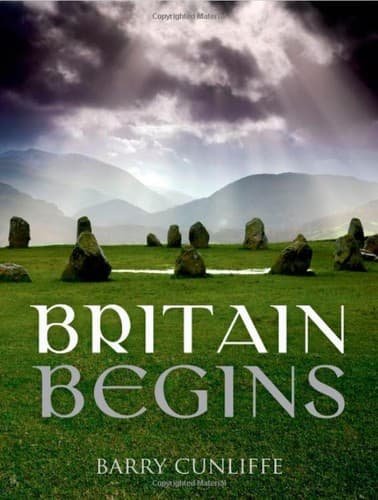
I was intrigued to learn more about my ancestors by a story I came across in the media. An extraordinary ceremonial site had been excavated and dated to 4300 years ago. There they found the skull of a long extinct auroch that was used as a headdress - it was estimated to be two thousand years old at the time it was placed into the water there! I had to find out more about the peoples that led such extraordinary lives for so many generations so long ago.
(https://www.theguardian.com/science/2018/jun/28/archaeologists-stumble-on-neolithic-ritual-site-in-suffolk)
This book did not let me down, though it may have left me pining for more. It is a first rate academic text on the history of the British isles from pre history through the age of the Northmen. I say academic as it is, but it is completely readable and most illuminating for the lay history reader like myself.
This is not a dense, theory led, and argument heavy book, rather a clear, measured, and evidence backed narrative of life on the British isles over many millennia.
As such it sticks firmly to the facts, or best evidence, with little time for imagining just what was going on day to day, who were these people and what did they believe, impossible to say but hard to stop day dreaming!
The book is excellent in all periods it looks at, pre history is heavy on things like geology, climate and food sources as archaeological evidence is sparse. Later we have more evidence of trade networks, belief systems, new peoples and ideas, and violent conflict.
The pre-roman times were the most obscured in my mind, and it was here I took the most from the book. Repeatedly mind blowing. The consistent and ancient sea links to Europe, often far flung Europe, in particular stick in the mind. As does the Western vs South East distinction that I feel even today!
It is hard to imagine the time scales involved here, we are significantly closer to Julius Caesar than he was to the builders of Stonehenge - and that was built on already ancient ceremonial ground.
To the authors credit the latter chapters on more familiar subjects - Romans, Anglo-Saxons, Norsemen are dedicated the same amount of page space despite a greater archaeological legacy, and he avoids the "superficial" and "tiring" "doing of celebrities" - the big names who won big battles in favour of the real important changes to societies and lives in the long run. Here I felt the writing of a true historian with a long view of history, a welcome alternative from the history of 'great men' that while fun, maybe takes up too much space on book shelves and in my mind.