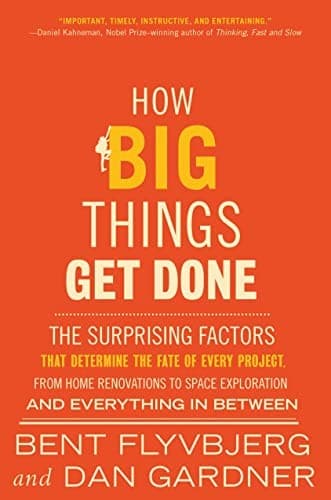
How Big Things Get Done: The Surprising Factors That Determine the Fate of Every Project, from Home Renovations to Space Exploration and Everything In Between
Bent Flyvbjerg
Read November 28, 2025
View on Goodreads →How Big Things Get Done
I really liked this book - kind of a "work-read" but makes the 5* in that genre. It is data driven, packed with clear and actionable insights, and framed around memorable stories like the Sydney Opera House, Heathrow Terminal 5, and the Olympics. The long case study of the Brooklyn couple doing a home renovation felt slightly out of place at times, but it is also very practical for normal people, especially if you have lived through your own mini construction situations!
Flyvbjerg’s core message can be summed up as: think slow, act fast. Spend serious time understanding what you are trying to do, why you are doing it, and how it has gone for others in the past. Then, once that groundwork is done, move quickly while the window of opportunity is open. The longer a project lingers half committed, unfinished, the more chances it has to fail.
Why are you doing this project?
One of the most useful ideas in the book is the insistence on a clear "why". Drawing on the architect Frank Gehry, Flyvbjerg describes the need to "fill in the box on the right": define the underlying problem, then outline the steps that will actually solve it. That simple discipline separates vanity projects from serious ones.
Linked to this is the idea of technology as embedded experience. The humble carrot peeler is an example of embodied test and learn, the physical outcome of many cycles of trial, error, and refinement. Good architecture is "embodied music" in the same sense, it crystallises experience.
Experience, experiment, and reference class forecasting
The book keeps coming back to the Latin root experiri, which underpins both "experience" and "experiment". You need both. Use what has already been delivered, off the shelf, by experienced people. Custom and bespoke sound glamorous, but in project terms they are often a red flag. Iterative processes and repeated patterns are safer.
This is where reference class forecasting (RCF) comes in. Instead of pretending you can magically predict cost and time from first principles, you pick a similar project as your baseline. You anchor your forecast in how long and how expensive it was in the real world, unknown unknowns included. According to Flyvbjerg, this approach is dramatically more accurate than traditional forecasting because it is grounded in reality rather than optimism.
I did raise an eyebrow at the positive HS2 example, which is interesting on paper but looks much less flattering given what we now know about the project’s later failures. That said, the underlying point stands: big, one off projects full of "black swan" events like archaeology, politics, and novelty are exactly where reference class thinking is most needed.
Psychology, stories, and the cost of failure
The book is very good on the psychology of big projects. Flyvbjerg goes after the popular myth of the lone creative or dropout genius who bends reality through sheer will.
Stories are seductive, and project managers love them. Survivorship bias means we constantly replay the few big success stories and ignore the vast graveyard of failures. Optimism bias in planning is dangerous, yet you still need some energy and drive to get anything built at all. That tension for PMs comes through clearly. Based on the data he quotes, true successful outlier projects are rare, maybe one in five. The other 80% are disasters, often with very long tail distributions of cost and time overruns.
Another great section leverages economics and looks at opportunity cost. When a grand project overruns or fails, it is not just the direct costs that hurt. All the other work that could have been done instead simply disappears. The opera house designer who was blamed and effectively exiled from the profession is a good example: we lost not just his reputation, but all the buildings he might have created afterwards.
Power, politics, and stakeholders
Flyvbjerg is blunt about power and vested interests. You need to know who actually holds power in your project and who has special interests at stake. The Olympics feature heavily as an example of some of the worst spending and overrun patterns in history. Every Games is treated as a one off, run by inexperienced locals who insist on uniqueness, and the result is almost always waste on a spectacular scale.
Modular construction and "What is your Lego?"
One of my favourite themes is modularity. Repetition is the mother of learning. Modular construction, when done well, is "magic" because it gives you scale without losing control. Flyvbjerg points to high end cars as proof that modular, repeatable systems can still be beautiful and high quality.
He also shows that the most successful types of projects in his database, in terms of time and cost, are the highly modular ones: solar farms, then wind, then coal and gas plants, electricity transmission, and roads. At the other end of the spectrum you find nuclear waste storage and the largest nuclear plants, plus mega events like the Olympics. These projects combine complexity, novelty, politics, and long time horizons in a way that invites disaster.
This all leads to the key question: what is your Lego? What are the units, modules, or patterns you can repeat, refine, and scale, instead of treating everything as bespoke?
The 11 heuristics
The book closes with 11 practical heuristics that act as a simple checklist for anyone leading projects, big or small:
Hire a masterbuilder: choose a leader with deep domain experience and a proven track record.
Get your team right: build a strong, experienced team, ideally one the masterbuilder has worked with before.
Ask "why?": clearly understand the ultimate goal and purpose of the project.
Build with Lego: use modular, replicable components; start small and scale up.
Think slow, act fast: invest time in thorough planning before moving quickly into execution.
Take the outside view: learn from similar projects; use real world data and reference classes.
Watch your downside: identify and mitigate risks; focus on avoiding catastrophic failures.
Say no and walk away: stay focused, avoid distractions, and be willing to abandon projects with poor prospects.
Make friends and keep them friendly: build and maintain strong relationships with key stakeholders.
Build climate mitigation into your project: integrate sustainability and climate considerations from the start.
Know that your biggest risk is you: recognise and manage your own biases and blind spots as a leader.
Verdict
For me, this is a very strong mix of narrative, data, and practical advice. The Brooklyn renovation story runs a little long compared to the mega projects, but it does make the lessons feel applicable to ordinary readers. If you care about how big projects actually work, or you manage any kind of complex initiative yourself, this is well worth your time.