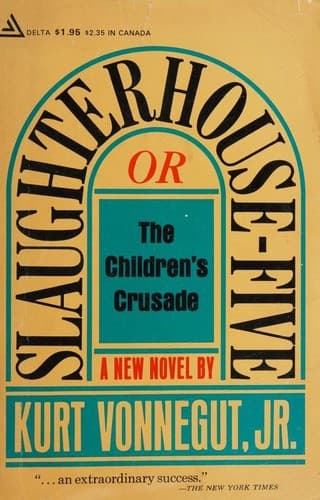
I went into this expecting a “war classic” and instead found something stranger - weird autobiography dressed as science fiction. Vonnegut opens by half-telling his own story, then hands it off to Billy Pilgrim, who slips in and out of time like a faulty radio. The famous bombing of Dresden is telegraphed from the first pages, but you don’t actually get there until very late in the book- after detours through a dreary middle-class American life enlivened by a trip to Tralfamadore, a planet where the aliens experience time differently (all at once) where Billy is installed in an alien zoo.
It’s deliberately jarring. The writing lurches between deadpan absurdity, black humour, and blunt horror. One moment Vonnegut himself is cameoing “shitting his brains out”, the next Billy is drifting through suburban America or lying in the rubble of Dresden. The result is a book that feels scattered, even unserious, it's probably the point - trauma doesn’t present itself neatly. Memory doesn’t run in straight lines.
Billy himself is written to be almost aggressively bland, which makes the violence stand out sharper and the humour more grotesque. You laugh at times, but the laughter curdles quickly. The book most reminded me of the Hitchhiker’s Guide to the Galaxy if you stripped out the British whimsy and left only the bleakness.
As an anti-war novel, it’s unusual because it doesn’t argue, persuade, or moralise. Instead it shows you either a fractured mind trying to process a world that no longer makes sense, or some weird aliens, and it forces you to sit with that. I admired the experiment and laughed at some of the darker jokes, but I can’t say I loved the reading experience and I am a little surprised at its "classic" status.
Overall: a strange, influential book that has major anti-war credentials that are not as obvious as say "all quiet on the Western front" - it maybe works more as a cultural artefact than a story I’d want to revisit.
*I checked at the numbers for the dead from the Dresden bombing are far in excess of what historians now think - but were the estimations at the time.