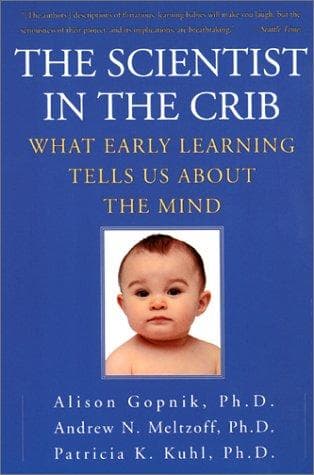
The Scientist in the Crib: What Early Learning Tells Us About the Mind
Alison Gopnik
Read June 15, 2020
View on Goodreads →Lucid and illuminating despite its relative age as a science book. 4.5 stars.
The general hypothesis is that babies learn quite like scientists do, or rather scientists remember how to think like babies! It plays out well, we see how babies encounter and overcome serious conceptual hurdles, the problem of other minds, that the world exists outside of subjective experience, and not just that sounds are words but that words have meanings. Doing this by making observations, predictions, theory building, and crucially adjusting or reprogramming these based on new data via a positive feedback circuit.
We also have solid theory building, notably the idea that we evolved a drive that takes pleasure from explanations of the world, from working things out. Paired with the 'pain' of confusion. This giving us a long term evolutionary advantage.
I say science book but I must add there is plenty of excellent and well written philosophy here too, it is explained that one of the authors studied philosophy at Oxford before pursuing developmental psychology, it shows.
The strongest sections (see the sections on language) seemed authored by Alison Gopnik. I see she also wrote 'the philosopher in the crib' not surprising and I'm sure also great! She writes well for the New Yorker too.
This is not a guide for raising children though it has helped me understand them more. Adding priceless depth to the little things each day. There are ingenious experiments that dispel common myths and break new ground. The sections on language even helped me with my French studies! The text is speckled with some astounding facts about babies brains! Truly fascinating.
The popular analogy of the brain as computer is used well here. In fact I was recommended this book by an AI researcher, the sections on AI remain prescient and well thought out even 20 years later. Brilliant to see both the progress (in some narrow fields) and the lack of it due to the hard issues babies solve so quickly! Interested to see the authors thoughts here now.
There are funny and touching anecdotes, plus an impassioned section on what matters in child development, though this also touches on the time the book is from - dating it to the Clinton administration. I'm sure new data and findings have pushed the field forwards to greater heights, with some of it probably from the authors. Small but unavoidable issue. I would have taken half a star off for this but I am compelled to add it back on for an excellent take down of post modernism.