AI Will Fix Bodies Before It Fixes Minds: Reading Dario Amodei on Health
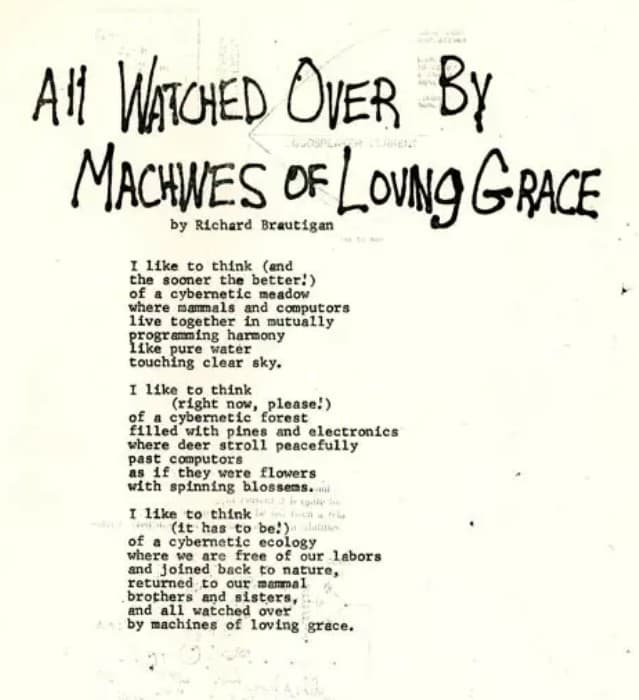
Part 1 Health: Why biology is AI’s lowest‑friction major win, what timelines make sense, and where mental health gets harder. Richard Brautigan's poem Anthro...
Part 1 – Health: Why biology is AI’s lowest‑friction major win, what timelines make sense, and where mental health gets harder

Anthropic’s CEO Dario Amodei has an excellent essay Machines of Loving Grace that envisions how AI can transform the world for the better. He covers five key areas where rapid advances driven by powerful AI will solve most of humanity’s problems in the decade after it is created.
To their credit Anthropic appears to genuinely prioritise research around serious risks in the field. But in this essay, Dario parks the doom-and-gloom early to focus on transformative positive outcomes while avoiding sci-fi utopias, promising to “touch the grass”.
The result? Predictions that, even while straying no further than 10 years post the release of ‘powerful AI’, can’t be called modest by any means. We’re talking about “a country of geniuses in a data center” propelling bona fide revolutions, potentially starting as early as 2026.
Today I want to focus on the part of his vision that has me most convinced, the potential revolution in human health and biology. This is where Dario’s case feels strongest, the timelines most plausible, and the benefits most undeniably positive.
Why Biology Is AI’s Low‑Friction Win
Dario envisions AI driving massive, rapid, and unambiguous improvement in biology. His core thesis is that AI could increase the rate of fundamental biological discoveries by 10x, compressing 50-100 years of progress into 5-10 years.
This would be possible as rather than simply being a superhuman data analyst, we would have thousands of top-tier virtual AI biologists who design, run, and improve experiments. They would create new techniques and technology as they power through a vast number of biological problems.
The maths is bold but compelling. As Dario notes, historically many biological breakthroughs like CRISPR and mRNA vaccines, have stemmed from the work of a small number of elite researchers. What if we could clone that elite talent 1000 times and run experiments in parallel?
The optimism comes down to what he sees as huge marginal benefits to intelligence in biology. Being just a bit smarter yields massive gains. Getting AI to elite human talent levels, then duplicating it enables problems to be solved in parallel.
This “compressed 21st century” would deliver:
- Reliable prevention of infectious diseases
- Elimination of most cancer
- Cures for genetic diseases
- Prevention of Alzheimer’s
- Improved treatment of diabetes and heart disease
- A potential doubling of human lifespans
Dario expands to include increased “biological freedom” – the ability for people to have more control over their weight and reproduction. This aims to tackle two massive problems in the developed world (at least before GLP-1 drugs started changing the game on weight). We will discuss reproduction in part 2.
The main limiting factor becomes time. Even with rapid, parallelised progress, animal and human trials are simply slow. After new treatment discovery, median clinical development to approval is ~8.3 years. This bottleneck is why Dario is more confident about revolutionary changes in 5-10 years versus enormous gains in just one or two.
He wonders if our kids will think of our diseases like we do of smallpox or bubonic plague – strange afflictions that terrorised our unfortunate forebears but that we simply dismiss from our minds.
Less Politics, Faster Proof
This section resonates with me more than the others for several reasons. First, health is the ultimate anti-killer app. It’s much easier to sell people on curing cancer than automating their jobs. The political resistance that might derail other applications barely applies here. The other big AI bosses often trot out the same lines for the same reasons.
Second, we’ve made incredible advances recently. mRNA vaccines went from concept to global deployment in record time. Gene therapy is moving from experimental to routine. CRISPR treatments are going mainstream. The foundations are there and AI acceleration feels like a natural next step rather than a fantasy leap.
Third, the intelligence-to-impact ratio does seem high in biology. Unlike economics or politics, where human irrationality creates persistent inefficiencies, biological systems follow discoverable rules. They’re complex, yes, but not arbitrarily so. More brainpower and greater bandwidth should equal better outcomes.
DeepMind’s AlphaFold remains the standout deep learning achievement, rightly earning Demis Hassabis and John Jumper the 2024 Nobel prize in chemistry. AlphaFold’s protein folding prediction abilities have saved hundreds of millions of research hours and are powering rapid advances.
Can this be repeated, and scaled? In many areas it’s not science fiction, it’s already happening. Importantly we do not require better than human intelligence here – just more of it will work great. Dario does seem to expect advances leading to better than human AI systems, but I find it harder to accept they can do this work independently this fast or that it will push through other bottlenecks listed here.
One scientific oddity that has always struck me is how often our greatest breakthroughs started as afterthoughts, pet theories, or ideas initially sidelined by the scientific establishment. Just in drug discovery the stories of antibiotics, rapamycin, and LSD spring to mind – a post for another day. What if we can increase bandwidth so that all ideas could be tested rapidly instead of waiting years for some curious graduate student or scientist with a ‘feeling’ to pick up the thread?
Mental Health: Harder Science, Heavier Ethics
Building on the same framework, Dario applies his “accelerated discovery” model to neuroscience and mental health. This is where things get more complicated.
He sees AI enabling us to cure most mental illnesses – addiction, PTSD, depression, schizophrenia. Even conditions like psychopathy might be addressable by reshaping adult brains through neuroplasticity or genetic interventions.
Beyond treating illness, he adds “mental freedom” to the list of benefits – enhanced focus, access to extraordinary states of consciousness, and improved baseline mental experiences. (He’s been reading the Culture book series 🙂 as we will discuss in part 3).
This matters as Dario suggests there may be more suffering from mental health problems compared to physical ailments. Almost everyone experiences suboptimal mental days.
We risk wandering into utilitarian or effective altruism (EA) territory here but for example if we could eliminate depression the way we (almost) eliminated polio, the reduction of suffering would be staggering. (Though we may lose some works of art that those who are afflicted seem able to produce).
I would urge caution about fundamentally altering how our minds have evolved to remove the likes of discomfort, frustration, and pain. They are still there for a reason – the rare condition where people can’t feel physical pain leads to terrible outcomes. We’re going to need to think this through but the first order benefits are clear.
Where the Health Narrative Breaks
Mental health strikes me as fundamentally trickier territory than physical health for several reasons.
First, the science will likely be harder. While we’re making progress in neuroscience, the brain remains far more mysterious than, say, cancer metabolism or genetic disorders. The gap between “understanding the mechanism” and “fixing the problem” feels wider.
Second, there’s often an added human layer of complexity that pure knowledge might not pierce. Many mental health challenges involve the interaction between biology, psychology, social context, and meaning-making. You can’t necessarily innovate or medicate your way out of existential despair, even with advanced neuroscience.
Third – and we’ll explore this much more in Part 2 – I’m not convinced that abundance and freedom will sit well with huge portions of the population. Sometimes the problem isn’t that our brains are broken, waiting to be fixed if only we were intelligent enough to understand how. It can be that our circumstances, driven by how we have evolved, are triggering responses in our minds – telling us something’s wrong. We may need meaning, work, a certain level of stress to feel ‘normal’. Balance would be key.
The potential for enhancing normal cognition also fascinates me. We already do this crudely with caffeine, modafinil, and meditation apps. What if we could reliably help people access flow states, improve focus, or experience the kind of clarity that usually comes only in rare moments?
Treatment versus Enhancement: Who Draws the Line?
Here’s where the mental health applications get philosophically interesting in ways that physical health doesn’t. If we can cure cancer, nobody asks whether we should. If we can eliminate genetic diseases, the moral calculus is straightforward.
But if we can reshape personality, enhance cognition, or chemically induce happiness – should we? At what point does treatment become enhancement? Who decides what constitutes a mental health “problem” versus just human variation?
I think about this as a parent. If safe, effective cognitive enhancement becomes available, do I give it to my kids? (probably not). Though we do much else to confer advantages to offspring, would it become disadvantageous to them if we don’t? See the excellent film Gattaca for a great exploration of a genetically enhanced future. Or the fun Limitless for superhuman intelligence in pill form.
What happens to society if we all optimise towards the same ‘ideal’ mental state?
Net‑Net: Health Still Wins
Despite these concerns, like Dario I remain bullish on the health applications of advanced AI. The opportunity to eliminate so much unnecessary suffering is right in front of us and AI can undoubtedly help.
Though I suspect we’ll get there more gradually even after very strong AI is launched. We’ll probably make mistakes, but we make mistakes with current treatments too. We’ll have a little time to figure out some of the ethical frameworks as the technology develops.
And unlike some of Dario’s other predictions in the political space, health improvements can largely happen within existing human institutions. We already have regulatory frameworks for evaluating medical treatments. We have established principles for balancing benefits and risks.
If Half of This Lands, Life Changes
If even half of Dario’s health predictions come true, over double the timeline, we’re looking at the most significant medical revolution in human history. We’re talking about alleviating an enormous amount of human suffering – both physical and mental. We would be able to live longer, healthier, and happier lives.
For parents like me, it means I may get to play with great-grandchildren, watching them grow up in a world where genetic diseases or cancer are stories great-granddad uses to scare them. A time where depression and anxiety are treatable with precision rather than the crude and inconsistent options we have today.
It also means we need to start thinking now about the philosophical and social implications. What would a world with even more old people than expected look like? Where do we draw the lines on prevention versus enhancement? How do we ensure these benefits reach everyone rather than just the wealthy?

Next: Work, Meaning, Inequality
The health revolution Dario describes feels not just possible but probable – though I’d argue arriving over longer timelines. Science is advancing rapidly, the incentives are aligned, and the benefits are clear.
In Part 2, we’ll look at the messier questions about economics, inequality, and what it means to live a meaningful life if traditional sources of purpose disappear. Spoiler alert: I’m significantly more sceptical about the timelines and optimistic outcomes once we leave the realm of pure science.